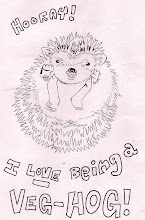
Halloo Happy Veggers!
I got an email today from APSCA that reminded me of the movie "Earthlings" Veg club attempted to watch (but it reminded me in a good way.)
When we tried to watch the movie, one of the scenes that stuck most in my mind was the unceremonious stuffing of dogs into gas chambers as a result of puppy mills.
The email I got said, "Hey you californian! You can call you senators to ban puppy mills in your state!!"
Naturally I was really excited, since I like puppies and don't like it when they're tortured/die a painful death.
This is the link it sent me: it asks you to put in your address to make sure you're a constituent in California, then leads to a link so you can contact your senators (Boxer and Feinstein, gotta love 'em.)
https://secure2.convio.net/aspca/site/Advocacy?alertId=2593&pg=makeACall&JServSessionIdr001=5vhaeltwm1.app224b
--KR
Wednesday, August 26, 2009

Saturday, July 11, 2009
Citizen's Climate Lobby
Halloo all!
Just today I went to a meeting with the La Jolla group of the Citizen's Climate Lobby. Its was pretty neat!
The Citizens Climate Lobby is a nationwide group composed of ordinary citizens, who are sick of Washington's playing to deep pockets and vested interests instead of what citizens and the world need.
So far we've sent people to D.C--real people, students even--to lobby congress as a counterbalance to the moneyed interests.
They're super cool! Want to get involved? Maybe talk to some congresspeople or send some letters to newspapers? Send an email to Veg to find out how :D)
--KR
Just today I went to a meeting with the La Jolla group of the Citizen's Climate Lobby. Its was pretty neat!
The Citizens Climate Lobby is a nationwide group composed of ordinary citizens, who are sick of Washington's playing to deep pockets and vested interests instead of what citizens and the world need.
So far we've sent people to D.C--real people, students even--to lobby congress as a counterbalance to the moneyed interests.
They're super cool! Want to get involved? Maybe talk to some congresspeople or send some letters to newspapers? Send an email to Veg to find out how :D)
--KR
Thursday, June 4, 2009
Fuel Efficient Cows?
That's right.
Fuel-Efficient Cows.
From Canada.
Figures.
http://www.biologicaldiversity.org/news/center/articles/2009/discovery-news-05-20-2009.html
Fuel-Efficient Cows.
From Canada.
Figures.
http://www.biologicaldiversity.org/news/center/articles/2009/discovery-news-05-20-2009.html
Saturday, May 30, 2009
Webcomic
Halloo all,
Finally got my F.eminist E.nvironmentalist V.egetarian A.ctivist H.umor (aka FEVAH) webcomic up.
It's going to be updating weekly :D
here's the first page:
http://kuakistar.comicgenesis.com/
hope y'all have fun :D
Finally got my F.eminist E.nvironmentalist V.egetarian A.ctivist H.umor (aka FEVAH) webcomic up.
It's going to be updating weekly :D
here's the first page:
http://kuakistar.comicgenesis.com/
hope y'all have fun :D
Tuesday, May 12, 2009
Petition: ban the gas cambers for animals in Michigan!
Halloo,
Found a relevant petition: banning gas chambers for animals in Michigan (its evil and nazi-like! Can't abide by it!)
http://www.thepetitionsite.com/takeaction/900398769?z00m=19761254
Found a relevant petition: banning gas chambers for animals in Michigan (its evil and nazi-like! Can't abide by it!)
http://www.thepetitionsite.com/takeaction/900398769?z00m=19761254
Saturday, May 9, 2009
Can food kill you?
Got this interesting article in my inbox:
http://food.change.org/blog/view/4_reasons_why_modern_agriculture_is_bad_for_you
I'm putting both the link and the full text article here because a: easier to read a full-text article if its in your face, b: the original website is pretty c: giving credit where credit is due, d: a lot of people wrote pretty intensive comments on the article--they merit reading.
"4 Reasons Why 'Modern' Agriculture Is Bad For You"
By Natasha Chart
The agribusiness and crop chemical companies are enamored of the word "sustainability" these days because, I guess, they think it's a magic word that can wipe the slate clean.
I just don't think anything can be considered sustainable that has such obviously bad effects on our health, and the health of the world around us. Swine flu's all the rage these days, but industrial agriculture didn't start being bad for us just this year.
So here are four of the negative effects of industrial agriculture on the well-being of people and the ecosystems we depend on, things that I don't think we can afford to keep doing in the long-term:
Genital feminization of male humans and animals: This one always gets them where it hurts, but the industrial pesticides used in agriculture are among the class of chemicals that mimics or stimulates estrogenic activity in the body and are linked, or suspected of being linked, to decreased sperm counts and genital abnormalities in male animals up and down the food chain.
Herbicides linked to cancer, neurological disorders: Nanaimo, British Columbia, has recently banned the use of herbicides on residential lawns based on the growing body of evidence that they're linked to a host of cancers, reproductive problems, respiratory illness and neurological effects from learning disorders to full-blown Parkinson's disease. The herbicides used on lawns are often just repackaged versions of the same chemicals, like Roundup, sold in bulk to farmers.
Antibiotics fed to livestock have created antibiotic-resistant bacteria: Called MRSA, methicillin-resistant Staphylococcus aureus, these difficult to treat infections commonly only attack people with compromised immune systems and were once more commonly associated with hospital environments. They don't seem to have developed forms that are very easily transmissible, but they keep showing up in farm environments where low-dose antibiotics are used as growth promoters and infection preventives.
Plants absorb antibiotics from soil amendments: If you use manure from an animal that's been given lots of antibiotics as a plant fertilizer, the plants will incorporate those antibiotics into their tissue. Even people who eat organic food, even people who have a totally vegan diet, can thus get our livestock antibiotics passed on to them in low, irregular doses - just about the worst possible way to take antibiotics. The genes that confer antibiotic resistance in bacteria don't necessarily help them survive any better in the environment at large; which is why penicillin has become useful again, because the resistance genes faded from the active bacterial population after it fell into disuse. Maintaining regular exposure of bacterial populations to antibiotics puts positive selection pressure on antibiotic resistance genes.
And these are just a few of the lowlights of factory farm and livestock production. I could go on.
Sustainability very specifically means something we can afford to keep doing for the forseeable future, but this ... How much more poison can the living things on this planet, including us, take? How much more endocrine system damage, how many more birth defects, can be incurred without risking the most basic means of continuing animal life on Earth? How many more superbug evolutions can we encourage without setting off a global pandemic that our rapid international travel can spread around the entire planet in days?
Any single one of these practices poses serious health threats if continued, in fact, poses serious health threats now. Is becoming steadily sicker and weaker as a population a sustainable proposition? Is our food going to literally kill us, and not just because of the diabetes and heart disease?
Truly sustainable agriculture needs to take into account not only issues such as phosphorus scarcity, but the injury limits on the health reserves of living beings.
http://food.change.org/blog/view/4_reasons_why_modern_agriculture_is_bad_for_you
I'm putting both the link and the full text article here because a: easier to read a full-text article if its in your face, b: the original website is pretty c: giving credit where credit is due, d: a lot of people wrote pretty intensive comments on the article--they merit reading.
"4 Reasons Why 'Modern' Agriculture Is Bad For You"
By Natasha Chart
The agribusiness and crop chemical companies are enamored of the word "sustainability" these days because, I guess, they think it's a magic word that can wipe the slate clean.
I just don't think anything can be considered sustainable that has such obviously bad effects on our health, and the health of the world around us. Swine flu's all the rage these days, but industrial agriculture didn't start being bad for us just this year.
So here are four of the negative effects of industrial agriculture on the well-being of people and the ecosystems we depend on, things that I don't think we can afford to keep doing in the long-term:
Genital feminization of male humans and animals: This one always gets them where it hurts, but the industrial pesticides used in agriculture are among the class of chemicals that mimics or stimulates estrogenic activity in the body and are linked, or suspected of being linked, to decreased sperm counts and genital abnormalities in male animals up and down the food chain.
Herbicides linked to cancer, neurological disorders: Nanaimo, British Columbia, has recently banned the use of herbicides on residential lawns based on the growing body of evidence that they're linked to a host of cancers, reproductive problems, respiratory illness and neurological effects from learning disorders to full-blown Parkinson's disease. The herbicides used on lawns are often just repackaged versions of the same chemicals, like Roundup, sold in bulk to farmers.
Antibiotics fed to livestock have created antibiotic-resistant bacteria: Called MRSA, methicillin-resistant Staphylococcus aureus, these difficult to treat infections commonly only attack people with compromised immune systems and were once more commonly associated with hospital environments. They don't seem to have developed forms that are very easily transmissible, but they keep showing up in farm environments where low-dose antibiotics are used as growth promoters and infection preventives.
Plants absorb antibiotics from soil amendments: If you use manure from an animal that's been given lots of antibiotics as a plant fertilizer, the plants will incorporate those antibiotics into their tissue. Even people who eat organic food, even people who have a totally vegan diet, can thus get our livestock antibiotics passed on to them in low, irregular doses - just about the worst possible way to take antibiotics. The genes that confer antibiotic resistance in bacteria don't necessarily help them survive any better in the environment at large; which is why penicillin has become useful again, because the resistance genes faded from the active bacterial population after it fell into disuse. Maintaining regular exposure of bacterial populations to antibiotics puts positive selection pressure on antibiotic resistance genes.
And these are just a few of the lowlights of factory farm and livestock production. I could go on.
Sustainability very specifically means something we can afford to keep doing for the forseeable future, but this ... How much more poison can the living things on this planet, including us, take? How much more endocrine system damage, how many more birth defects, can be incurred without risking the most basic means of continuing animal life on Earth? How many more superbug evolutions can we encourage without setting off a global pandemic that our rapid international travel can spread around the entire planet in days?
Any single one of these practices poses serious health threats if continued, in fact, poses serious health threats now. Is becoming steadily sicker and weaker as a population a sustainable proposition? Is our food going to literally kill us, and not just because of the diabetes and heart disease?
Truly sustainable agriculture needs to take into account not only issues such as phosphorus scarcity, but the injury limits on the health reserves of living beings.
Saturday, April 25, 2009
Battery/Cage Dilemma Resolved
So ever since I read the two articles in favor of the battery-caged hens, I have been haunted with uncertainty and self-doubt. I finally emailed Kath Rogers, a fellow environmentalist on the UCSD campus, about the whole matter, and here is the email I got back:
"Hey Steph!
SO good to hear from you!
I'm so glad you asked that question - I saw that article too and here’s my response to it (sorry it’s lengthy!!!).
The farm described in that article is called Armstrong Egg Farms, and they are not objective in this debate. Armstrong contributed $65,000 into the "No on Prop 2" campaign in California. The owner, Mr. Armstrong, was the guy flying around the state to defend battery cages during the Prop 2 campaign. He was the sole person who showed up in opposition to us when lots of us testified in support of Prop 2 at the San Diego city council meeting (the council ended up supporting Prop 2!). He regularly speaks out against cage-free egg production and was a spokesperson for the agribusiness coalition that unsuccessfully fought against Prop 2.
Armstrong Farms is a huge egg farm which uses lots of battery cages. He created a (very) small portion of his farm which produces "cage free" eggs. His "cage-free" hens are crowded, dirty, old and many are losing feathers--and he wants to keep it that way for his public tours, so that he can "prove" that battery cages are good. He offers "comparative tours" of very young (ie, white and fluffy) hens in battery cages and then a tour of older (missing some feathers) cage-free hens, and then say: "See -- hens are better off confined in battery cages."
In reality, scientific analyses of the various systems all come to a far different conclusion from that of Mr. Armstrong. The definitive review of the science on this topic is at http://tinyurl.com/5rbkkl , and concludes: "Regardless of how a battery-cage confinement system is managed, all caged hens are permanently denied the opportunity to express most of their basic behavior within their natural repertoire. The science is clear that this deprivation represents a serious inherent welfare disadvantage compared to any cage-free production system." A much shorter summary is available from the Humane Society at: http://www.hsus.org/farm/camp/nbe/compare.html
This is not to say that cage-free is totally cruelty-free because I still have problems with the fact that all farms destroy the male baby chicks because there is no use for them, etc. However, battery cages are one of the worst forms of animal cruelty - caging animals so that they can barely move for their entire lives. This is why all of the animal welfare and environmental organizations pushed so hard to pass Prop 2 to ban battery cages, including The Humane Society of the United States, ASPCA, Center For Food Safety, California Veterinary Medical Association, Sierra Club, Clean Water Action, Union of Concerned Scientists, and Center for Science and the Public Interest.
Let me know if that answers your question. We should definitely stay and touch and work together on for animals and the environment on campus - I transferred in the fall, and am now officially a senior, so I'll be here for another year! Thanks for all of the AMAZING work you guys are doing with VEG - I'd like to get more involved with it!
Talk soon!
Kath"
I can finally sleep again.
"Hey Steph!
SO good to hear from you!
I'm so glad you asked that question - I saw that article too and here’s my response to it (sorry it’s lengthy!!!).
The farm described in that article is called Armstrong Egg Farms, and they are not objective in this debate. Armstrong contributed $65,000 into the "No on Prop 2" campaign in California. The owner, Mr. Armstrong, was the guy flying around the state to defend battery cages during the Prop 2 campaign. He was the sole person who showed up in opposition to us when lots of us testified in support of Prop 2 at the San Diego city council meeting (the council ended up supporting Prop 2!). He regularly speaks out against cage-free egg production and was a spokesperson for the agribusiness coalition that unsuccessfully fought against Prop 2.
Armstrong Farms is a huge egg farm which uses lots of battery cages. He created a (very) small portion of his farm which produces "cage free" eggs. His "cage-free" hens are crowded, dirty, old and many are losing feathers--and he wants to keep it that way for his public tours, so that he can "prove" that battery cages are good. He offers "comparative tours" of very young (ie, white and fluffy) hens in battery cages and then a tour of older (missing some feathers) cage-free hens, and then say: "See -- hens are better off confined in battery cages."
In reality, scientific analyses of the various systems all come to a far different conclusion from that of Mr. Armstrong. The definitive review of the science on this topic is at http://tinyurl.com/5rbkkl , and concludes: "Regardless of how a battery-cage confinement system is managed, all caged hens are permanently denied the opportunity to express most of their basic behavior within their natural repertoire. The science is clear that this deprivation represents a serious inherent welfare disadvantage compared to any cage-free production system." A much shorter summary is available from the Humane Society at: http://www.hsus.org/farm/camp/nbe/compare.html
This is not to say that cage-free is totally cruelty-free because I still have problems with the fact that all farms destroy the male baby chicks because there is no use for them, etc. However, battery cages are one of the worst forms of animal cruelty - caging animals so that they can barely move for their entire lives. This is why all of the animal welfare and environmental organizations pushed so hard to pass Prop 2 to ban battery cages, including The Humane Society of the United States, ASPCA, Center For Food Safety, California Veterinary Medical Association, Sierra Club, Clean Water Action, Union of Concerned Scientists, and Center for Science and the Public Interest.
Let me know if that answers your question. We should definitely stay and touch and work together on for animals and the environment on campus - I transferred in the fall, and am now officially a senior, so I'll be here for another year! Thanks for all of the AMAZING work you guys are doing with VEG - I'd like to get more involved with it!
Talk soon!
Kath"
I can finally sleep again.
Subscribe to:
Posts (Atom)